

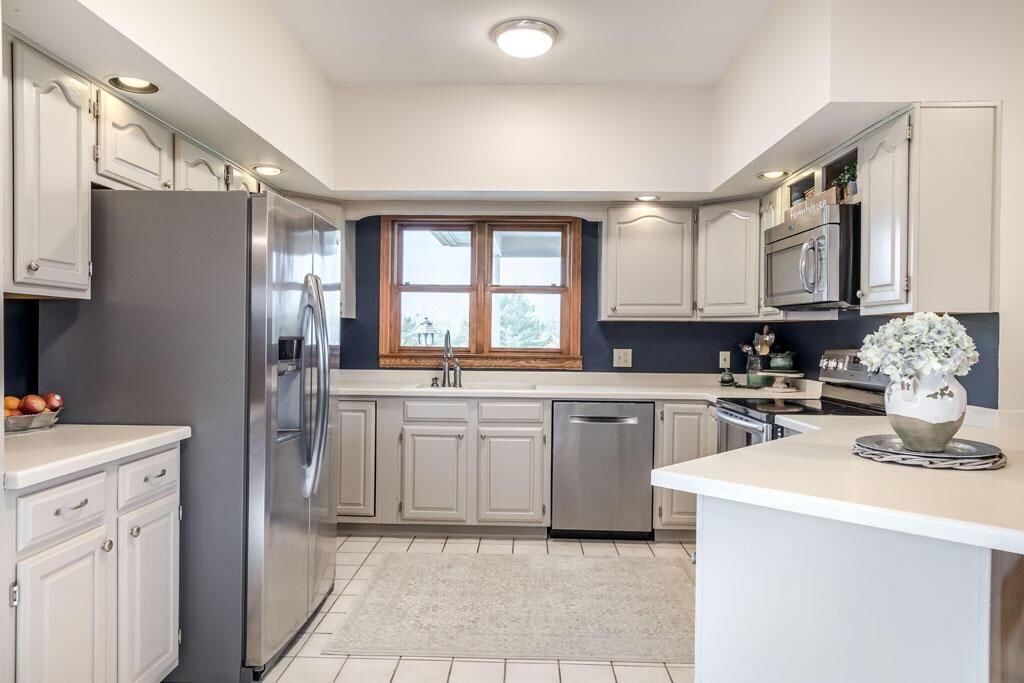
If your kitchen feels dated, cramped, or closed-in—even after updating countertops, cabinets, and lighting—there may be one big reason: bulky kitchen soffits. These boxed-in structures above your cabinets are common in older homes (especially from the 70s, 80s, and 90s), and they can make your kitchen feel smaller, darker, and less modern. Many homeowners start planning a remodel and wonder, “Should we remove the soffits and open everything up… or leave them alone?” The challenge is that soffits aren’t always just cosmetic—sometimes they hide plumbing, wiring, ductwork, or structural elements, which can turn a “simple demo” into a bigger project.
At JSB Home Solutions, we’ve spent decades remodeling kitchens across Central Ohio, and we’ve helped homeowners navigate this exact decision many times. We’ve seen soffits that were purely decorative—and soffits that were hiding important mechanical systems. That’s why we always approach soffit removal with a smart plan: evaluate what’s inside, understand the impact on cabinetry and layout, and help you decide what makes the most sense for your kitchen goals and budget.
In this article, you'll learn what kitchen soffits are, why they exist, and the real pros and cons of removing them during a remodel. We’ll also walk you through a simple step-by-step process to help you make the right decision for your home—so you can move forward confidently and create a kitchen that looks better, functions better, and truly feels updated.
Table of Contents
Why Do Home Owners Want To Remove Their Kitchen Soffits?What is a Kitchen Soffit and What is its Purpose?
Pros of a Kitchen Soffit Removal
Cons of Removing Your Kitchen Soffits
5 Steps to Make a Decision on Your Kitchen Soffit Removal
Ready To Make A Decision on Removing Your Kitchen Faucets?
Why Do Home Owners Want To Remove Their Kitchen Soffits?
.jpg?width=404&height=610&name=Borgerding%20%20SK%20Prof%20After%20(34).jpg) One of the biggest benefits of soffit removal is the ability to install taller upper cabinets—often all the way to the ceiling. This gives you the extra storage every kitchen needs, especially for items you don’t use every day like serving platters, seasonal dishes, or small appliances. Instead of collecting dust above the cabinets, that space becomes usable storage that helps keep your countertops cleaner and your kitchen more organized.
One of the biggest benefits of soffit removal is the ability to install taller upper cabinets—often all the way to the ceiling. This gives you the extra storage every kitchen needs, especially for items you don’t use every day like serving platters, seasonal dishes, or small appliances. Instead of collecting dust above the cabinets, that space becomes usable storage that helps keep your countertops cleaner and your kitchen more organized.
Removing soffits can also dramatically improve the overall style and visual height of your kitchen. Without that bulky boxed-in area, the room feels taller and more open, and your cabinetry becomes a stronger design feature. This is especially helpful in older kitchens where the soffits make the space feel closed off or heavy. With modern cabinet layouts, clean lines, and upgraded lighting, soffit removal can make your remodel look more high-end and intentional.
Another major advantage is that soffit removal creates more flexibility for your kitchen design. It can allow for improved cabinet layout options, a more seamless transition to crown molding or ceiling finishes, and a cleaner look around features like range hoods or tall pantry cabinets. Many homeowners are surprised by how much more “custom” the kitchen feels once those soffits are gone—even if the rest of the layout stays the same.
Finally, soffit removal can increase the long-term value and appeal of your home. While every remodel decision should be made for your lifestyle first, a kitchen with ceiling-height cabinetry and a clean, updated look tends to feel more current to future buyers as well. It’s one of those upgrades that makes a big impact visually—and often makes the entire kitchen feel newer.
What is a Kitchen Soffit and What is its Purpose?
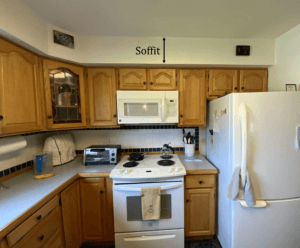
A kitchen soffit is the boxed-in area that sits between the top of your cabinets and the ceiling. It’s essentially a built-in “bulkhead” that’s framed out with lumber (usually 2x4s) and covered in drywall, creating a hollow space above your upper cabinets. In most homes, kitchen soffits are around 12–18 inches tall, although the exact height depends on your ceiling height and the type of cabinets that were installed.
Kitchen soffits were especially popular in homes built in the 1970s, 1980s, and 1990s, mainly because they helped kitchens look more “finished” when shorter cabinets were common. Instead of leaving an awkward open gap above the cabinets, builders would fill the space with a soffit to create a clean line across the top. In some cases, soffits were also used for a practical reason—they can act as a hidden pathway (often called a “chase”) for things like ductwork, plumbing, and electrical. You might find heating and cooling vents, drain pipes, water lines, or wiring inside a soffit. This is especially common with plumbing, since drain lines rely on gravity and sometimes need extra space to slope downward properly.
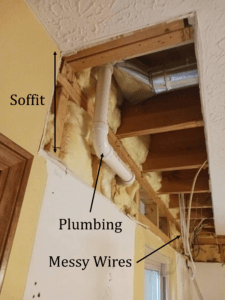
In many kitchens, soffits weren’t originally built to hide plumbing or ductwork—but over time, they can become a convenient “catch-all” space for different trades during construction. Sometimes electricians or plumbers will run wires or pipes through the open soffit area simply because it’s faster and easier than routing everything neatly through the framed walls. It saves time during the build, but it can create complications later—especially if you’re planning a remodel and hoping to remove the soffits for a cleaner, more modern look.
No matter how the ductwork, wiring, or plumbing ended up inside the soffit, one thing is true: if you want the soffit gone, those services usually have to be rerouted first. In some cases, that’s a fairly simple adjustment with minimal extra work. But in other situations, it can turn into a much bigger project that affects your timeline, budget, or even the layout of your kitchen. That’s why it’s so important to weigh the pros and cons of kitchen soffit removal early in the planning process—so you can make a smart decision based on what’s actually behind the drywall, not just what you see from the outside.
Pros of Removing Your Kitchen Soffit
For most homeowners, removing kitchen soffits is one of the most exciting parts of a remodel—because it instantly makes the space feel more modern, more open, and more custom. Even though soffits were originally used to “finish off” the gap above cabinets, today they often make kitchens feel boxed in and outdated. When you remove them, you’re essentially reclaiming vertical space that can completely change the look and function of the room.
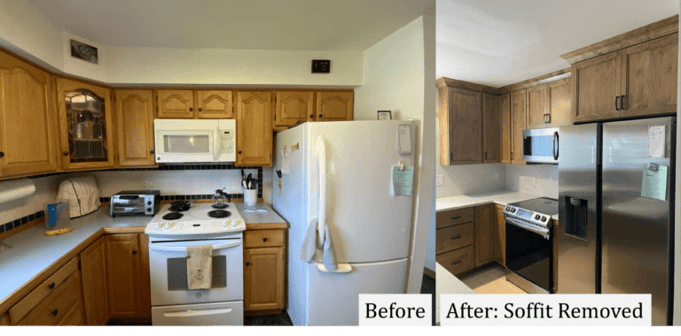
One of the biggest benefits of soffit removal is the ability to install taller upper cabinets—often all the way to the ceiling. This gives you the extra storage every kitchen needs, especially for items you don’t use every day like serving platters, seasonal dishes, or small appliances. Instead of collecting dust above the cabinets, that space becomes usable storage that helps keep your countertops cleaner and your kitchen more organized.
Removing soffits can also dramatically improve the overall style and visual height of your kitchen. Without that bulky boxed-in area, the room feels taller and more open, and your cabinetry becomes a stronger design feature. This is especially helpful in older kitchens where the soffits make the space feel closed off or heavy. With modern cabinet layouts, clean lines, and upgraded lighting, soffit removal can make your remodel look more high-end and intentional.
.jpg?width=438&height=290&name=Coyne%20-%20SK%20Prof%20After%20(9).jpg) Another major advantage is that soffit removal creates more flexibility for your kitchen design. It can allow for improved cabinet layout options, a more seamless transition to crown molding or ceiling finishes, and a cleaner look around features like range hoods or tall pantry cabinets. Many homeowners are surprised by how much more “custom” the kitchen feels once those soffits are gone—even if the rest of the layout stays the same.
Another major advantage is that soffit removal creates more flexibility for your kitchen design. It can allow for improved cabinet layout options, a more seamless transition to crown molding or ceiling finishes, and a cleaner look around features like range hoods or tall pantry cabinets. Many homeowners are surprised by how much more “custom” the kitchen feels once those soffits are gone—even if the rest of the layout stays the same.
Finally, soffit removal can increase the long-term value and appeal of your home. While every remodel decision should be made for your lifestyle first, a kitchen with ceiling-height cabinetry and a clean, updated look tends to feel more current to future buyers as well. It’s one of those upgrades that makes a big impact visually—and often makes the entire kitchen feel newer.
Cons of Removing Your Kitchen Soffits
Even though most homeowners want their soffits gone, removing them isn’t always as simple—or as affordable—as it looks. The biggest reason soffit removal can become complicated is because you don’t always know what’s inside until the project begins. Some soffits are truly empty and purely decorative, but others hide important mechanical systems like ductwork, plumbing lines, or electrical wiring. If that’s the case, the soffit can’t just be removed—you’ll first need to reroute whatever is running through it, which adds extra labor, cost, and planning.
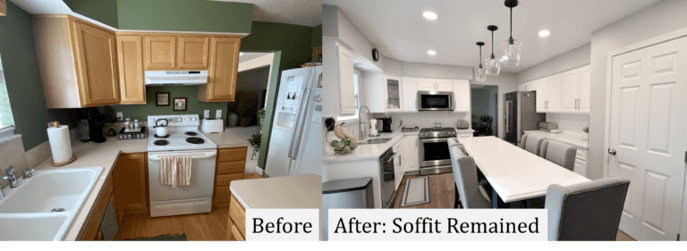
Another downside is that soffit removal can impact your budget and timeline more than homeowners expect. Once the soffit comes down, the space often needs drywall repair, ceiling patching, refinishing, and sometimes even repainting larger areas so everything blends seamlessly. In some kitchens, removing soffits also reveals uneven ceiling lines, unexpected gaps, or framing challenges that require additional finishing work to make the remodel look polished.
It’s also important to understand that soffit removal often leads to a bigger design decision: what happens next with the cabinets? If you remove the soffits but keep the existing cabinet height, you may end up with a large open gap above the cabinets that looks unfinished. Many homeowners choose to install taller cabinets to take advantage of the new space, but that can increase the overall cabinet cost. In other words, soffit removal can sometimes create a “domino effect” where one change leads to a larger remodel scope.
And finally, there are some cases where removing soffits simply isn’t practical. If the soffit is hiding major HVAC ductwork that can’t be easily moved, or plumbing that would require extensive rerouting, the cost may outweigh the benefit. In those situations, it may be smarter to keep the soffit and focus on other upgrades that give you a bigger return—like new cabinetry, lighting, countertops, or a more functional layout.
The bottom line? Soffit removal can be a fantastic upgrade, but it’s not automatically the right choice for every kitchen. The smartest approach is to evaluate what’s inside the soffit and weigh the cost against the storage and design benefits—so you can decide if it’s truly worth it for your home.
5 Steps to Make a Decision onYour Kitchen Soffit Removal
Remodelers should walk you through a plan of action similar to these five steps before guaranteeing soffit removal.
-
Identify the soffit(s) that you wish to have removed.
This is as simple as pointing it out to your contractor. -
Determine what is inside your soffit.
Without any visible clues as to what is running through your soffit, many remodelers will cut a hole in the soffit to explore what is hidden behind the scenes. The hole can then be repaired if you decide against soffit removal. If your soffit is empty, fantastic! Jump to step 4. Otherwise, continue to Step 3. -
Determine if the things inside your soffit can be rerouted.
Your contractor will be able to tell you what it will take to reroute any surprises in your soffit. -
Decide on a contingency plan.
Every kitchen soffit removal intent should come with a contingency plan, even if the soffit appears to be empty with an exploratory hole. There are just too many unknowns when trying to remove a soffit and peeking into one spot through a small hole is not a fail-proof system. These unknowns are the source of the surprisingly high costs to remove “just some drywall and studs.” You want this contingency built into your proposals so that you are prepared once your soffit has already been ripped open, just to find that you have to put it back because hidden items cannot be rerouted. -
Weigh the cost and time commitment with the storage and aesthetic payoffs.
In the end, weighing the potential costs with aesthetic and storage upgrades can prove a very challenging decision. Ultimately, you will have a beautiful new kitchen, even if your soffit remains. Align your budget and renovation goals for overall project success. If you want to add more storage to your kitchen through your renovation, you could accomplish this by removing your soffit and adding taller cabinets. If soffit removal does not fit in the budget, then you know you need to find additional storage elsewhere in your plan.
Ready To Make A Decision on Removing Your Kitchen Faucets?
That kitchen soffit has become an eye-sore in your kitchen and you are ready to transform the look and feel of your space by taking it out of there. But, is the money spent on a kitchen soffit removal actually money well spent on your project?
In the end, removing your kitchen soffit is only one piece of your kitchen remodel. While an important decision, understanding the total cost of a kitchen remodel and the time commitment will help you in deciding whether kitchen soffit removal will fit in your overall project.
Consider all the other pieces that go into a kitchen renovation: cabinets, backsplash, sink, appliances, and more. Does removing the kitchen soffit determine if your project becomes your dream kitchen? If you want to see what is in your kitchen soffit, fill out the form below for an in-home consultation.


Topics:
